




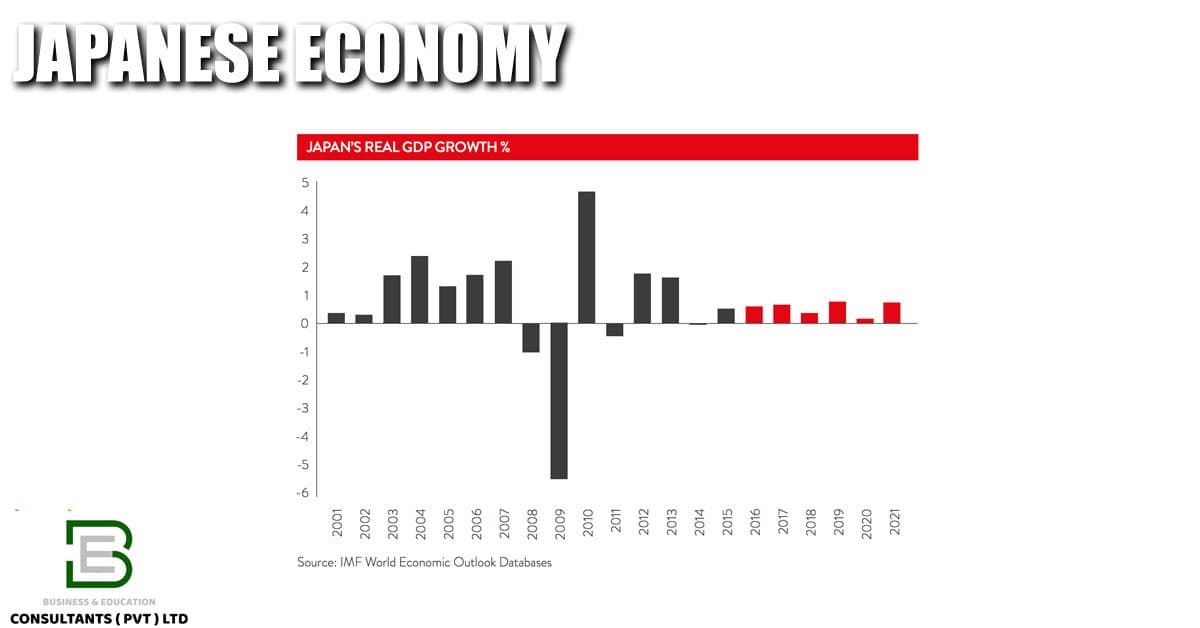
The Japanese economic factors and strategies can describe as one of most referral & implemented economic concepts in the world, they made their foundations & basics in 1603 (Edo period 'current Tokyo') & then it managed to rise as the non-European power with good economy in 1868 & after the 2nd world war in 1945 the Japan able to state as the world second Largest economy,A period by period Japan had a growing economy until the day today, the Time period of 'Edo' it developed the handicraft industry & constructions trades & the urbanization starts in this time period which brought Japan a flourished economic value, The rice cultivation can mention as the main vocation which Japan built its internal economy & stability, After the mid-19th century country opened for its self for western market & businesses, the western base education systems were introduced to Japan & after they quit the law which were limiting Japanese to overseas they sent lot of students to USA & other Europe countries for educational purpose & as well they hired the people from western to obtain the modern science technologies & the languages as well.The government involved to help privet sectors & allocate the resources for them since the companies were helping to bring the money value inside to the country, the government built the shipyards & allowed privet sectors to manage the businesses.
In Infrastructure, Japan produced its energy mostly using the petroleum, Coal & gas & with the nuclear power they managed to produce the energy until they close down all their 50 nuclear plants due to 'Fukushima Daiichi nuclear disaster (11th march 2011)' demonstrating the country is nuclear free.
Japan has a really developed & well maintained infrastructure system both government & privet sectors controlling this services frequently to provide a good service to the general public.
The highways, express ways & railways (the length of Japan's railways is 23,670km) & Japan has the most upgraded & high speed trains in the world & the country is surrounded by the water & it has very comprehensive sea transportation system as well where Japan includes many Ports & 660 ship approximately.Japan's telecommunication system is highly advanced which is controlling by both privet & public sectors the 'Nippon & Telegraph' are the largest privet service providers in Japan & there were 350(approximately) of internet providers in Japan which is helping & controlling all the economical & personal requirements.
The Main industries which bring Japan extensive economic values can mention as below.
- Automobile industry
- Consumer Electronic
Automobile industry
Japan is the world's 3rd largest automobile provider in the world in 1960 japan surpassed the Germany & rapidly increased its business through the 3 decades 1970 to 1990, in 1990 they estimated Japan's automobile production as 13 million cars per year, in 2012 Japan showed the annual production as 9.9 million automobile, Japan started to build automobiles in middle 1910 with create trucks & other vehicles which are mainly helping their farming & stock moving activities since they had no big market for personal vehicle purposes at that time & they start to do the partnering with other automobiles brands in world, they let them sell their products in Japan such as 'Isuzu , Nissan & Austin & after the 1970 Japan automobile industry had a flourishing time period where brought Japan an immense economic value, in year 2000 Japan stated as the world's biggest car producing nation in the world the brand names are, “ Toyota, Honda, Daihatsu, Nissan, Suzuki, Mazda, Mitsubishi, Subaru, Isuzu, Kawasaki, Yamaha, and Mitsuoka” Japan automobile industry can mention as its biggest economy runner which has catch whole world with a good quality & brand name as well with a reliable prices to low end customers to high end market, In 2016 'Toyota Prius' was the bestselling car model in Japan, in this year Japan showed the bestselling trends for Hybrid cars, the units are (Prius- 356,560, Aqua 194,390, RAV4 98,780, Aurus 93,983 & Yaris 87,223) & after this rising year there were no down trend for Japan Hybrid cars but to the Up.
Consumer Electronic
Everywhere the world you hear the Japanese electronic items are the best with the high Quality & super condition and the lifetime of the product. Japan takes the 1st place in world for Consumer electronic production, sale, Quality & the brand names, the main competitors are 'China, South Korea & Taiwan' the major Japan electronic brands includes the names 'Pioneer, Sony, Yamaha, Canon, TDK, Toshiba JVC Kenwood & etc., their leading products Video cameras, High technology Video game players, Mobile phones, Lap tops, the computer components, Micro Chips etc.
With their internet oriented business methods with low cost it help all the ordinary & all the citizens to have an access to global market, Consumer electronic accounts takes the 3rd main Japan economy provider.
In 2008 Japan struggled with financial lost & losing the market share due to the actions of Rival companies in South Korea & Taiwan, the economic crisis of Hitachi & In 2011 the leading companies Sony & Panasonic stated immense lost estimated as 420 billion yen in the year end & it was a huge hit to the Japanese economy, However in the present Japan still the world's largest Electronic item provider & earning millions of Dollars which bring Japan an economic Revenue.
Labor Force
Japan had a strong labor force, as reports say in 2008 there were 66 million workers 40% of them were women, in 2005 it can noticed that there were more deaths in Japan than births, due to this declining of Population the barriers to immigration were removed & allowed foreign to migrate Japan for study & working purposes.
concept of home robots was also proposed by Japan.
Trading
The main trading partners are the United States, East Asia, Southeast Asia, and Saudi Arabia. The volume of trade with mainland China and Asia has grown significantly.
Long-term maintenance of super. The main imported items are mainly raw materials, including petroleum, iron ore, semi-finished products and food.
Exports automotive, electronics, home appliances, machinery and industrial robots.
Financial
In the Edo period, the Tokugawa shogunate implemented a financial policy. In addition, wholesale banks and so on began to operate the lending industry.
After the Heisei era, the collapse of the bubble economy and the many adverse events that occurred in the country's financial and economical provinces, the stock price and real estate prices plummeted in the late 1990s, and the large number of corporate closures brought a large number of toxic assets to Japanese financial institutions.
The low rate led to the collapse of the large-scale Japanese listed banks such as Hokkaido Takushoku Bank, Japan's Long-Term Credit Bank and Japan Bond Credit Bank, and the financial system's crisis.
The government formulated a timetable for financial institutions to reduce non-performing assets. It has raised 120 trillion yen in capital injections into financial institutions, lowered interest rates and implemented ultra-loose financial policies.
After years of difficult adjustments, financial institutions have finally regained their vigor, and toxic assets have been drastically increased. Decline, further increase in capital adequacy.
In the first half of 2005, Rezone Financial Holdings earned a net profit after tax of 174.3 billion yen. The average non-performing assets of major financial institutions have fallen below 3%, and the economy is seeing a recovery.
However, in 2008, the U.S. sub-loan financial tsunami broke out in a full-scale, and the sub-prime-related losses of the four major Japanese banks from 2007 to 2008 are expected to reach US$4.7 billion, which is approximately 30% of their expected profits.
The financial industry's prosperity is related to financial products based on the US bubble. Most financial institutions in Japan are accustomed to investing gold into high-risk, high-risk subprime-related products.
At the beginning of 2009, Nomura Holdings' profits fell by 71% and Mitsubishi UFJ Financial Group fell by 68%. After the disclosure of subprime mortgages, many financial institution assets have fallen back to the levels before the domestic bubble economy in Japan.
Natural Reserves
Crude oil and iron ore production is minimal. Underground resources are scarce (but various minerals have been found in Japan, which is known as the “Energy Museum”).
However, raw materials for cement, such as limestone, glass, and some building materials, such as quaint stones, are abundantly stored and have been extensively mined. In the past, large quantities of gold, silver, copper and coal were produced.
In the Warring States period, it was once the world's major gold producer. There are still a large number of coal deposits, but the quality is low and there is no mining.
There are still some gold or silver rich mines, but mining is very low due to high mining costs. The coast of the Japan Sea produces a very small amount of oil and natural gas.
There is the extraction of natural gas in the Boso Peninsula. A large number of gold, silver, petroleum, and combustible ice deposits have been discovered in Japan's coastal areas.
However, due to cost considerations and no mining plans, it is still in the investigation stage. Timber resources are equally abundant.
There are many fishing grounds in the open sea, and the amount of fish is the highest in the world. However, because of the over-fishing of sardines, the fishery resources are facing a crisis of drastic reduction.
The climate is warm and humid, rainfall is high, and water and soil are well maintained. Therefore, Japan has a lot of high-quality soft water, and the quality of beverages produced is high.
Government involvement
Japan government divided to 3 branches, Executive branch, Legislative branch, judicial branch, and Japan government works with the system adopted in 1947 contain 47 administrative divisions, Prime minister is the head of government & he takes the final decisions of controlling, the government involvement for the economy has many channels, the ministry of finance & the ministry of international trade & industry (MITI), the Ministry of finance responsible for all fiscal intelligence such as plotting the national budget & controlling the GNP as well the formulates the Taxes & controlling part of economic resources, Japan government obligated to control all the flows of its economy & promoting all their services & work on the innovations & developments, the ministry of transportation response for all bulk & normal transportations modes throughout all the transport channels such as sear & air ensuring the smooth & swift flow of national economy.The Japan is the nation which has very lowest tax rates & highest technology & natural resources & populace which can bring country an enormous financial values & revenue & their social cutler find very polite & full of hospitality now a day they have open the country for all the Asians to migrate & study in Japan which will gradually spreading the technology to the world, Japan has built an invincible financial value to be a leading nation in the world so far.