




The Japanese economy is getting better day by day. The level it is at present is highly remarkable.
Hard working, inventing new knowledge, dedication and new thinking have led Japan to today's economic level. To achieve this they started at some point during early times.
If history could talk, it will fill you with evidences of Japanese economic success as well as failures. So let the economic history of Japan to fascinate you.
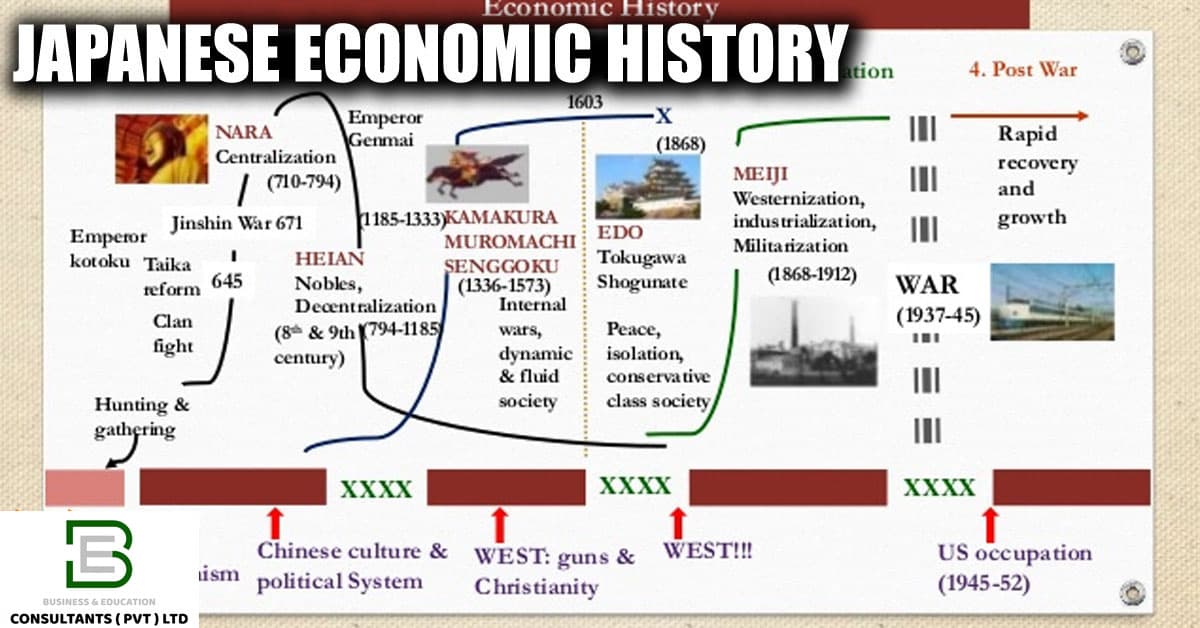
1\. Nanban Trade Period
When renaissance hit Europe, they wanted more metals for their work. That's when the Europe found Japan as something valuable, as Japan is rich in valuable metals.
Eventually, Japan became the major exporter of silver and copper to Europe during that era. The first Portuguese ship with Chinese goods came to Japan in 1557\.
As there were no relationship between China and Japan, the Japanese had no access to Chinese items. So this ship was a fortune for the Japanese.
Then in 1600, the Dutch arrived to Japan and in 1605, the English too arrived. Eventually, the Dutch chased away other nations and became the only one who had access to Japan.
They remained in this position for two centuries after 1638\.
2\. Edo Period
The Edo period emerged during the last decades of Nanban period. During this era, the Japanese could build their very first Western style warship and they sailed it first to America and then to Europe.
Meanwhile, the Japanese sailed around 350 Red Seal ships within the Asian region for trade. Once they realized that they were being attacked by Christianization, they decided to isolate.
During this isolation, they made their economy stable with mild progresses. Some of the major economical developments which followed this era are as follows.
- Urbanization
- Improvements in shipping commodities
- Expansion in both domestic and foreign commerce
- Diffusing handicraft industry and trade
- Rising in agricultural industry, making rice as the base of the economy
- Introduction of banking facilities as well as merchant associations Eventually, Osaka and Kyoto became very busy trading cities and Edo became the center of food and all the other urban consumer good supply. Japanese tried their best to study about the science and techniques in West and they became success in that.
3\. Meiji Period
In 1854, Japan again opened themselves for Western commerce and this resulted in a rapid growth in their economy. Textile industry showed a rapid development.
When it reached to 1890s, the Japanese textile market could successfully compete with the British textile products and they could dominate the markets of India and China. Japanese shippers did a great job in reaching their products to the European market by competing with European shippers.
Japanese government ended the feudal system, marking the biggest impact on economy during this era. With this people started to engage in more trades as they could invent and sell their own products.
No matter how much they were focused on growing their economy, the Japanese did not forget about education too. An increase in education can be noted throughout the economic history of Japan.
Being educated opened more doors in inventing new technologies, making Japan a powerful nation in both economy and military. The government sent young people to America and other European countries to gain the Western knowledge.
Meanwhile they hired about 3000 Western teachers to teach in Japanese schools. Improvements of roads and rail tracks took place during this time.
The Japanese government decided to help the private business sector too. This decision further increased their economy.
The banks developed their systems and offered more funding to entrepreneurs.
4\. 20th Century
During the world wars, many powerful nations had to face a collapse in their economy. However, the Japanese managed to suffer less than the other countries.
They improved their military power during this time. But, the agricultural sector had to go through a nightmare.
After the world wars, the Japanese did their best to regain what they lost. The oil crisis attacked Japan in 1973 and this was one of the biggest challenges they had to face in their economic history.
But, this led the Japanese to invent other power sources. Since then, they have being climbing up in their economic development ladder despite some minor drawbacks.