




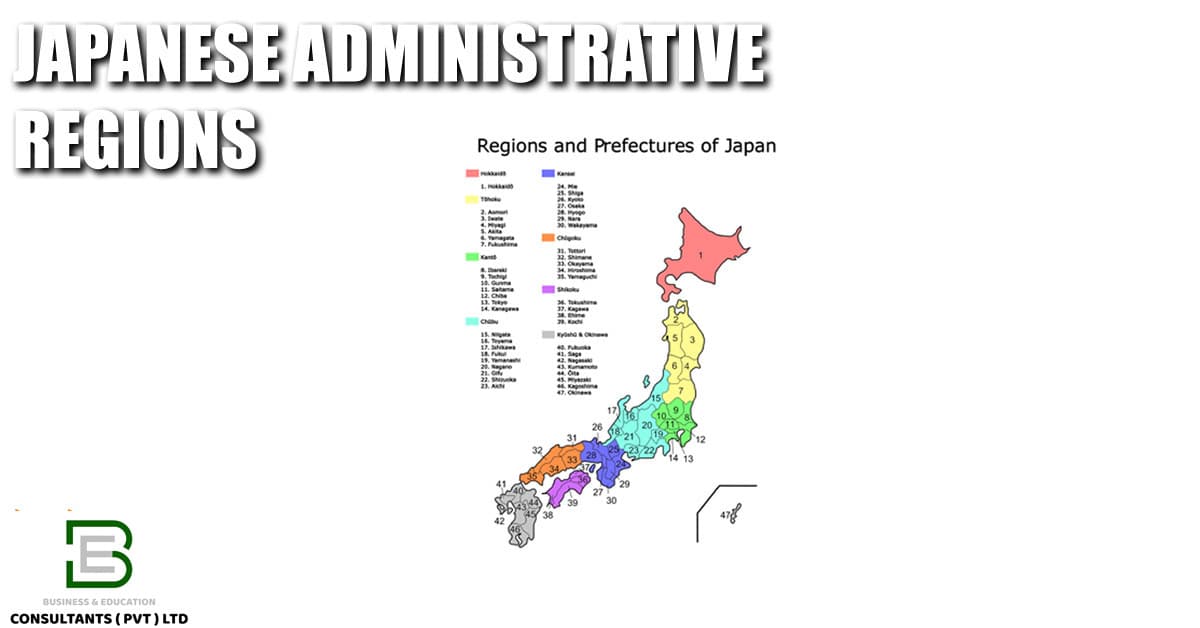
Japan's administrative divisions usually obligate two levels.
- The first-level districts are split into the capitals, the prefectures, the counties, and roads
- The second-level regions are split into the cities, the towns, and the villagesBoth Metropolitan Municipalities and Municipalities are called local public administrations and local self-government is carried out. This means that according to the wishes of residents, according to democratic principles, local politics and administration are implemented. Prefectures and counties are wide-area local public bodies including municipalities, and are superior institutions of municipalities. Japan is divided into a total of 47 prefectures, namely 1 (Tokyo), 1 (Hokkaido), 2 (Kyoto, Osaka), and 43 counties. Among them, Hokkaido has the largest area of 83,519 square kilometers, the smallest is 1,876 square kilometers in Osaka Prefecture, the largest population is the capital Tokyo, more than 13 million people, and the least is Uteon County, about 600,000 people. Cities, towns, and villages are grassroots administrative organizations. The Japanese village is equivalent to our country's township and has rich rural and agricultural characteristics; the town has more urban characteristics than the village, which is equivalent to our country's town; the city is a larger town than the town, but there is no district, nor is it With a comprehensive dispatching agency, only a certain number of offices, windows, etc., need to be set up according to individual job requirements. There are more than 3,200 municipalities in Japan, of which the most populous city is Yokohama, which has 3 million people, and the less populous Toyama village has only 200 people; the largest area is Shimao Village, which has 1,400 square kilometers and the smallest area, Iyo-cho, is only 1.5 square meters.Factors to setting up a city There are four conditions for setting up a city in Japan
- The population is more than 50,000
- The number of households in the central urban area accounts for more than 60% of the total number of households in the city
- The proportion of the population engaged in urban business accounts for more than 60% of the total population
- In accordance with the regulations of the prefectural and prefectural ordinances, All necessary facilities of the city, such as institutions of higher learning, libraries, and the status of environmental health and social service facilities are provided. In order to promote the merger of Machida, Japan has twice reduced the city's standard and stipulates that a city with a population of more than 30,000 may be established in a given period. Therefore, some of the existing cities have less than 50,000 people. The establishment of the municipality was initiated by the municipality concerned, approved by the metropolitan prefectural assembly, and agreed upon with the Minister of Home Affairs.The setting conditions of the town are stipulated by the metropolis and prefectures themselves.
- There are three conditions governing the prefectural government of the Tokyo Metropolitan Government:
- The population is 18,000 or more;
- The number of households in the center area accounts for more than 50% of the total number of households in the region;
- The self-employed population accounts for more than 80% of the population in the entire region. In order to solve the problem of the ever-increasing size of the city, the Japanese government revised the "Local Self-Government Act" in 1956 and stipulated that "designated cities" could be set up. The meaning of a designated city is that any city with a population of more than 500,000 or more that is more developed and designated by the cabinet through a government decree, the state gives it a certain amount of authority equivalent to capital, prefecture, county, and road, and enjoys urban planning compared to the general city. There are 17 special jurisdictions such as the prevention of infectious diseases and the organization of various welfare programs. In this way, many matters in designated cities can be directly supervised by the competent ministers without being supervised by prefectures and counties, and in many respects are similar to our country's plan cities. At present, there are 10 designated cities in Japan. They areOsaka, Nagoya, Kyoto, Yokohama, Kobe, Kitakyushu, Chuanqi, Fukuoka, Sapporo, and Hiroshima. The population of these 10 cities exceeds 1 million. In addition, there are more than half a million people in eight cities such as Jieshi City. These cities are required to become designated cities, but they have not been approved by the Minister of Home Affairs.