



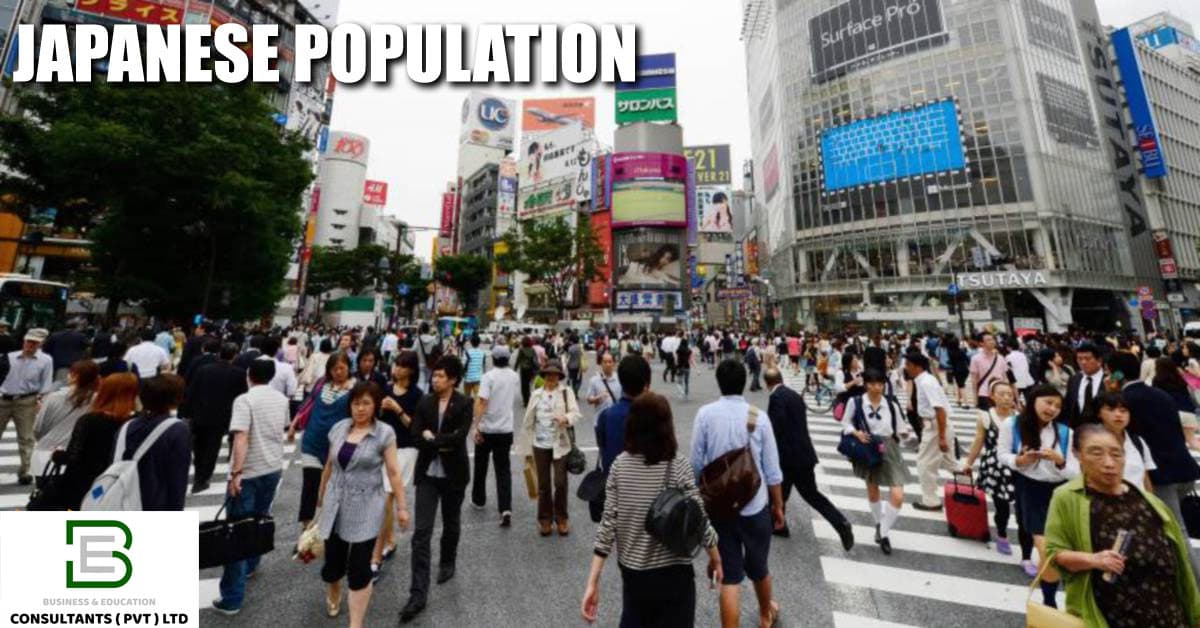
By population, Japan is among the top ten countries in this respect \- the number of inhabitants of the archipelago is about 130 million people. The average density of the country's population is very high \- 340 people per 1 km 2 (it should be borne in mind that the land suitable for habitation is less than a third of the total area and comparable in size to the territory of the Moscow region, thus, the real density of population is much higher). Despite the high population, the population of Japan is distinguished by an exceptional national homogeneity. The number of persons of non-Japanese nationality here is calculated as fractions of a percent. Among the national minorities of the country, Koreans and Chinese are the most numerous. Americans and Europeans (30-40 thousand people) are considered, as a rule, temporary residents. Aboriginal Japanese islands \- Ainu, living on the island of Hokkaido since the XI millennium BC. There are no more than 20 thousand. At the end of the XIX century the Ainu were forced out by the Japanese and lost their best lands. Currently, they live in isolated villages, are engaged in agriculture, livestock, and are hired for fishing. Only the older generation of Ainu retains their language and culture. Since the beginning of the twentieth century, the rural population of Japan has been steadily declining. At the moment, more than three quarters of the inhabitants of the country are citizens. 60% of the urban population (i.e., in fact, the bulk of the country's population) is concentrated in four major metropolitan areas, located around the cities of the so-called "big four" \- Tokyo, Osaka, Nagoya and Kitakyushu.
Population Growth
The rate of population growth in the country is quite high \- over the past century the number of residents has more than quadrupled. The highest birth rate in Japan reached after the 2nd World War. The "boom of childbearing" lasted until 1950, after which it again declined, but given the considerable successes of the Japanese in the field of medicine and health, which led to a sharp decline in infant mortality, the rate of population growth remained consistently high. Only in recent decades, the rate of population growth has stabilized, and now it is beginning to decline. The mortality rate of the adult population also decreased. Health indicators of Japan are among the best in the world. According to the data of 1989, the average life expectancy of men was 75.9 years, and for women \- 81.8 years. Due to these factors (reduction in mortality, fertility and increasing life expectancy), the process of the population's "aging" is a characteristic feature of Japanese society (and becomes a problem). In 1970, the proportion of residents over 65 years exceeded 7% \- the mark that is accepted in international practice as a boundary for classifying countries as "old societies". It is expected that by 2000 this share will rise to 16%, i.e., surpass the level of any European country where the aging process has also gone very far. The tendency of the "aging" of the economically active population is the result of the aging process of the entire population of Japan. However, in comparison with it, it does not develop so quickly. At present, most of the increase in the economically active population is made up of residents of the country from 55 to 65 years of age. In addition, the retirement age determined by the state is very high, and after the 1983 reform it was 65 years for both men and women.
Current Status
In recent years, two numerical values have been announced one after another on the declining population.
- One of them is the population decline actually confirmed in the census published in 2015\. The total population was about 127,095,000 people, about 963,000 fewer than the previous survey five years ago. It decreased for the first time in about 100 years since the initial survey in 1920\.
- The other is that the number of annual births in the next 2016 breaks down for the first time to one million people, staying at only 9,800 people.Of course, Japan does not disappear in recent years. However, as you look at future population estimates in units of 50 years and 100 years, the more Japanese people are, the fewer it will be. The National Institute of Population and Social Security Research (hereinafter referred to as "Human Resources Institute") has revised the "Future Estimated Population of Japan" (2017) for the first time in five years, but this document explores Japan's future map I will draw. The total population of Japan that counted 127 million as of 2015 will be less than 90 million in 40 years and will be reduced to 50 million in less than 100 years. There are many people who know this estimate because it is taken up repeatedly in the media, but there is no analogue in the world history that the population suddenly decreases like this. We live in a very unique era in a long history. Although it is not well known, there is a continuation of this company's estimate. In "desk calculations" with certain conditions, it will be reduced to about 13.8 million people in 200 years and to about 4.5 million people in 300 years. The Japanese archipelago where the population density should have been very high worldwide is that it will be in a state of being sky full from now. Three hundred years later is a far-away future figure that anyone living in the present cannot confirm. However, 4.5 million people have made Fukuoka prefecture (about 5.1 million people) a little small. You can see that the declining population in Japan is not a tough level such as the annihilation of rural areas. We predict this "Desk Calculation" even further far. It is said that there are only 6000 people living in the Japanese archipelago in the year 2 900 AD, and how much it will be reduced to 2000 in the year 3000 AD. Japan will not become a state as a state before it is reduced to an extreme so far. On the contrary, the Japanese itself may become registered as "endangered species". In short, even one bullet is unnecessary for the state to perish. It is the extinction of the state that waits for the end of the society's arrival where the child is not born, as more people talk about "It will not get married, have children, do not have children, it is personal freedom''.
- #### 21\. Problems