Japan is one of the greatest nations of all the time. Japanese people never consider time together as time wasted. They rather call it a time invested. Every single fact about Japan turns out as amazing. It goes with the politics too. Japan politics is as amazing as the country itself and there are many things you need to know about it.As Japan is a country with a very long history, there politics have undergone many changes with time. Their current political system is running for the last 71 years. Let me ask you a question. What's the first thing that pops into your mind when you think about political system of Japan? Of course, the Royal family and the prime minister. Japan is a country with a constitutional monarchy, where the government consists of a Royal Emperor and the national government. The government is the decision maker and the ruler of the country, with the prime minister being the leader. The royal family is well respected in the whole country, but they have no political power. They mostly engage in charity work and traditional events. In simple form, the royal family is the jewel of the country.
Power Division
In Japan politics, the Emperor is considered as the head of the state. The prime minister himself acts as the head of the government as well as the head of the Cabinet. He has powers to lead the country with the members of House of Councilors. The legislative power of the country relies on the National Diet. The Nation Diet consists of two parts; the House of Representatives as well as the House of Councilors. In Japan politics, there are two main conditions for candidate and to be a member of the House of Councilors. You need to have a Japanese citizenship and you must be 30 years or older, if you need to sit in the House of Councilors. Every representative of House of Representatives should be 25 years or older. When it comes to judicial powers, it is vested on the Supreme Court as well as on other lower courts. Japanese citizens are a very important part in their political system. Sovereignty is vested on the citizens by the Constitution of Japan.
Selecting the Prime Minister
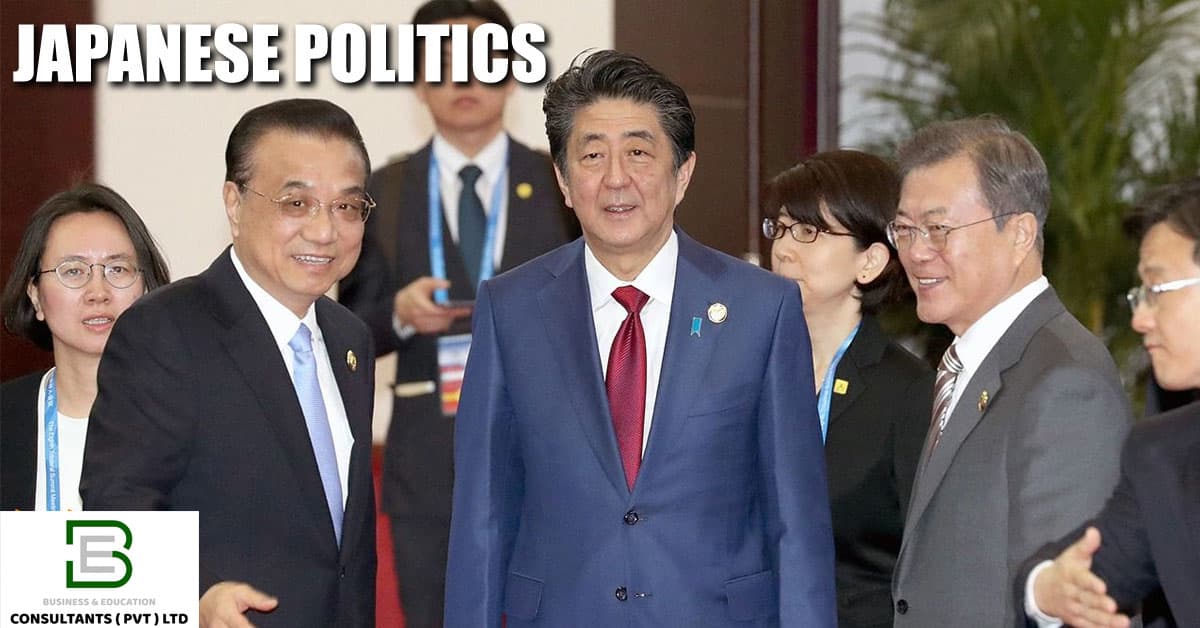
As mentioned earlier, the prime minister is the leader of this great Japanese nation. But, in Japan politics, the citizens don't get to vote directly and choose their prime minister. Instead, all the political parties compete for the election separately. The winning party is selected by the direct vote of citizens. Then the party with majority votes elects the prime minister from their party. Shinzō Abe is the current prime minister of Japan and he is the 57th prime minister. He is the leader of Liberal Democratic Party and has being the prime minister since 2012\.
Voting Age
Until recently, the minimum age requirement for voting was 20 years. But from their last election, the minimum age was dropped for 18 years. So now in Japan politics, every Japanese citizen on or above 18 years have the right for voting. The true story behind lowering the age limit is the recent decrease in voting polls. So the government decided that lowering the age limit would increase the number of people going to the polls.
Moreover
In the Japanese government, the ministers of each province are all rubber stamps (political metaphor) The only thing that really matters is the president of the province. People are the civil service system. All the way up is the politicians and the civil servants are not superior and inferior relations. The minister cannot control the civil servants under his own hands. A light pole commander. This system can actually operate. Most of Japan's policies come from the professionalization of professional civil servants. The politicians are basically merely public opinion advisors. The politicians can really say the finals, that is, the legislative level, but the designation of specific laws is still largely to be Listen to civil servants' opinions. A similar situation was seen in the Minister of Ministers. However, Sir Han Fule was only operating in secret. The Japanese side has not only flagrantly overheated leaders but has long been institutionalized. There is also a very important path in the Japanese political circle, that is, when civil servants leave the post after their retirement/retirement, they enter the political arena as members of Congress, and further ensure that the opinions of civil servants can be understood and valued by politicians. Because civil servants' policies directly affect companies and companies support members of the legislature, they form a coalition of “Civil Service” companies. Members who speak for the XX industry call “XX families” in Japanese. They participate in the legislative work as civil servants and corporate spokespersons. As a result, Japanese politicians also broke the cans, cooperated with civil servants very happily, politicians performed at the front desk, and civil servants worked in the background to bring Japan's shady political tradition to the extreme. The way in which Japan administers the country is that each department meets first, and then the heads of each department meet together to discuss the national affairs. After reaching a conclusion, the cabinet is notified and the cabinet announces it to the public. There are always two or three the people in Japanese literary works who determine the circumstances of the country's events because the reality is this. The industrial affairs are decided by two or three senior civil servants in the Ministry of Industry and the direct execution of the decisions, the Prime Minister and the minister has only the right to know and has no decision power. Of course, there is also a politician who has a great ability and a strong idea. It is against the civil service system. Previously, the Democratic Party's the cabinet wanted the politicians to directly direct civil servants at the central level.