The transportation system of Japan considers as one of greatest progressive transport systems in the whole world. Railways provide an opportunity to get to almost anywhere in the state. In addition, the arrangement of highways is well established, as well as air transport of the country. In the cities, transport links are provided by buses and taxis (round the clock); ferries connect the cities of Tokyo, Osaka, Kobe with the main ports of the islands of Hokkaido and Kyushu. Prior to the introduction of steam engines and internal combustion engines, Japanese rulers were not very favorable at activating traffic. The reason for this is holding tradition and order and military reasons. In "Nihon Shoki" as well, there are many gods ("Arasami") that disturb people's traffic (the "Arasami") and the existence of local people, even immediately after Taika's revival, travelers are not contemplating the customs of the area There are descriptions that it is regarded as being problematic that local people have punished themselves for committing them. In order to form a state as a nation, major roads connecting the capital and the prefectures of the countries are also maintained in Japan. However, transportation between rural areas was supposed to help escape farmers, so it was hardly maintained except for major government offices, and it was thought that only in the regional river should be handed over at the Funabashi when carrying the annual contribution to the capital ( Extraordinary calendar of " Japanese epoch " May 20 Jujo). Also from the military and political reasons in the Edo era, not hung a bridge to the large rivers, seclusion (Umikin policy) and of Ofuna construction ban (Buke ShohattoIn addition to being issued, we adopted a policy to prohibit logistics using vehicles such as cattle cars in the highway road due to the Edo defense. For this reason, Japanese roads are rarely paved, and vehicles using wheels were used only for carrying baggage, such as a large octave, there were only cow carriages. Restrictions on the use of horses were also added. Kawatani and small commercial merchant ships are used to transport goods, and waterways have developed in large cities. After the Meiji Restoration, Japan will grow to a modern state. It was given priority to build a railway network. Regarding roads, full-scale maintenance began after the Second World War. In the period of high economic growth, a highway, a full-fledged car road, first appeared in Japan (Meishin expressway). After that the maintenance of the Shinkansen and the city highway began with the Tokyo Olympic Games in 1964 and the Osaka World Expo in 1970 and now the expressway network with a total length of 14000 km has been developed and the maintenance of the Shinkansen has also progressed. However, with the progress of motorization, the decline of the central urban area has been strained in various aspects.
Transportation Took a Kick-Start after the World War II
The development of roads for automobiles did not advance much until the end of the Second World War, and the pavement rate was very low even in the national highway. For the economic recovery, the Nagoya · Kobe Expressway (current Meishin expressway ) connecting Nagoya and Kobe was planned, but since the engineers of traffic engineering who can plan the expressway were not in Japan, the United Nations The plan was drawn up requesting. That is the Watkins report issued in 1956\. Among them, "Japan's road is incredibly bad, as industrialized countries, there is no other country than ignorance of the road in this way". This report is also boosted, and Japan's road development will progress dramatically. In order to speed up in the railway steam locomotive from DMU conversion to and from (diesel car) electrification went underway.In Japan, which was restricted in the development of aircraft due to the defeat of the aircraft, it did not hurt in the field of aircraft manufacturing, but many of the technicians active before the war ended up supporting the growth of the Japanese automobile industry by changing over.Together with the Tokyo Olympics in 1964, the construction of the Tomei highway and the opening of the Hokkaido Shinkansen were followed one after another. The capital highway in Tokyo also opened partly in 1962, which was also the first urban expressway in Japan. From the latter half of the 1960s, the popularity of my cars got into full swing and the number of cars increased sharply (motorization). On the other hand, traffic accidents also increased drastically due to delays in improving the use environment of roads and cars, and it was called traffic war. The appearance of the reckless family also became a problem. As a countermeasure to prevent traffic accidents, walking vehicle separation was carried out by installing crosswalks such as crosswalks. The number of cars owned reached 10 million units in 1971\. Although the conventional railway stagnates by the wave of progress of motorization, the high-speed passenger railway Shinkansen will grow to the Japanese aorta. The success of the Japanese Shinkansen that fills the gap between automobile and air passenger transportation has increased the momentum to review the railroads that were in a tendency to stagnate and motivated Europe and Asian countries to also introduce high-speed passenger railways. In Japan, which relies heavily on overseas resources, shipbuilding technology has been developed since the war, and large tankers and other constructions were actively made after the war, together with the steel industry, played a part in Japan's economy and logistics. The maintenance of the airport was promoted and the air transportation gradually expanded. After the 1980s when the value of yen further increased, business and traveling abroad to overseas became active.
Road System
The Japanese road was poor until the period of high economic growth, but road construction was actively carried out since the 1960s, high-level road improvement is spreading throughout the country. Construction of highway has also progressed, and the highway network is being developed almost throughout the country. Although the number of deaths due to traffic accidents has decreased due to the progress of safety measures, the number of traffic accidents continues to increase because traffic volume is increasing and the aging of people is advancing. From the current fiscal situation the road development budget tends to be compressed, institutional changes such as the privatization of the public road public corporation and the general revenue source of specified road revenue sources are occurring
Railway System
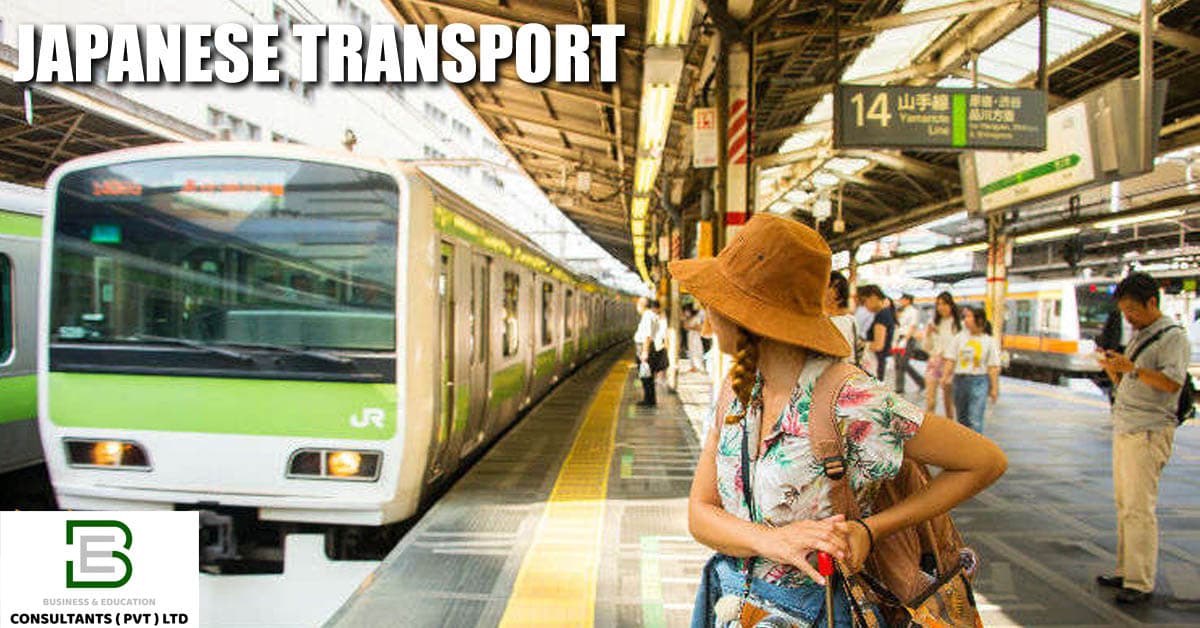
In Japan, the demand for railroads is very large, especially in urban areas, and subways and commuter railway lines are being improved, but in rural areas the usage of railways has continued to decline as the use of cars continues, there are also routes to be done. Meanwhile, the demand for the Shinkansen is still large in areas where bullet trains are not maintained due to the convenience of transportation and economic development. In rural areas existing lines are made into light rails (Toyama Light Rail), parking lot for park & ride is being developed. JR Tokai has decided to develop the Central Shinkansen, which is a linear motor car system, and the speeding up of the railway network in Japan will be further advanced
Bus System
It is responsible for transportation within cities, transportation between residential areas and villages and the nearest railway station. In metropolitan areas, the number of customers has decreased due to the expansion of the subway network, in the suburbs and rural areas, the use of private cars and the depopulation, etc., the number of customers has decreased, the restructuring of the routes, the spinning by the region, the abolition of the routes has been done There. General bus routes can be classified into four. Route bus that carries out inter-city communication (dozens to hundreds of kilometers) using highways, there are daytime and night flights. There is no official definition by the Ministry of Land, Infrastructure, Transport and Tourism under jurisdiction. In general, these high-speed buses are very popular due to the fact that many railroads connect cities that do not go straight and because the fare is low, which is a field that is easy to profit among bus services. However, some big city operators have withdrawn from long-distance routes. Tokyo metropolitan area Keihanshin in the route connecting the major cities, such as also seen competition with low-cost membership tour bus by tourist bus
Taxis in Japan
There are 04 main taxi services in Japan and Taxi stands are established at stations, airports, ports, department stores, sightseeing spots, downtown areas, hospitals, etc. get on line in order (at Tokyo station etc., say "Please get on first come first served" It is basically in compliance with the landing guidance staff). Choosing a taxi vehicle is basically a freedom of a customer, and in recent times, when the wishes of a wagon taxi or payment other than cash is desired due to diversification of vehicles and payment methods to be described later, cases where changes in order are accepted There Some buildings, hospitals, etc., a crew member of a superior ranked business operator selected by a taxi center, and a crew member who has a good witness certificate issued by a taxi center can enter. In the case of Tokyo, Tokyo Station Marunouchi side and Shibuya station west entrance Etc.) And a dedicated stand where only specific businesses can enter. In some taxi stands dedicated to a specific business operator, a taxi company to enter may pay the facility fee to the facility the owner and purchase the campaign right. Even in the case of a dedicated stand for a specific business operator, when a customer arrives at the platform when the vehicle of the business operator is not on standby or when he / she comes pick up by calling a customer, the vehicle of another business enters Sometimes.