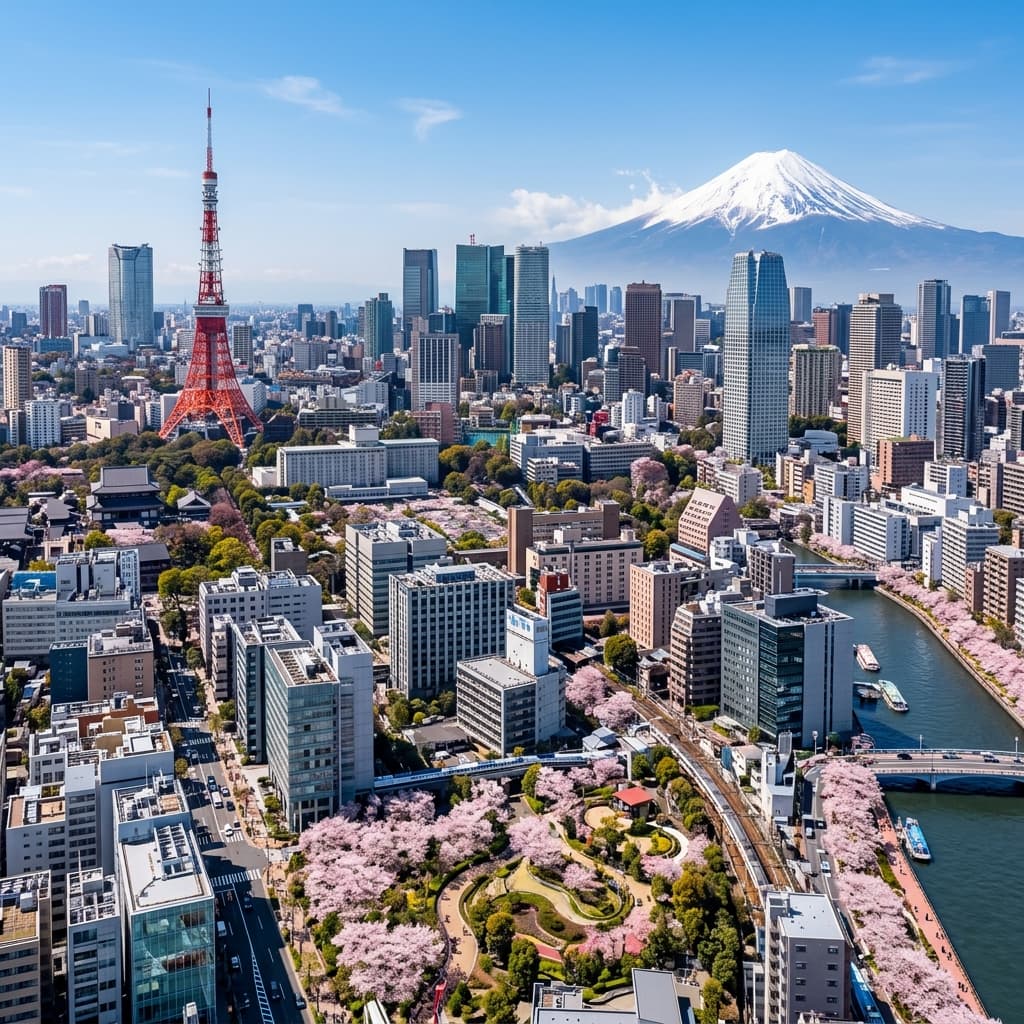






When it comes to Japan's science and technology, Japan is way ahead from the other countries in the world and the whole field was backed by a grate history as well as the future of the science and technology and is very promising and has a bright journey. Before we talk about the particular topic's fields there are good at, let's have a look at the factors that bought them up here. Here we go\!
Extensively establish scientific research institutions and recruit skilled personnel
One of the notable features of Japan's post-war development this field and is that it has a wide range of research institutions, a wide distribution, a reasonable structure, and talented people. The central level scientific research organizations have a large number of personnel and strong strength, and they play a leading role in the development of this massive field. By the beginning of 1973, the Research Institute of the Department of Science and Technology had six research institutes with 1,656 researchers, and the scientific research budget for 1972-1973 was 89 billion yen. 4 In addition, many provinces, universities, and private management units have established numerous scientific research institutions. For example, the Ministry of International Trade and Industry has set up the Industrial Technology Institute, which includes 13 scientific research and laboratories. The research fields include metals, mechanics, cosmic rockets, atomic energy conversion, chemistry, and automation control. There is a financial institute under the Ministry of Finance, a radio wave institute under the Ministry of Posts and a Statistics and Mathematics Research Institute, a Labor Health Research Institute, and so on.
The great majestic nature of science and technology
Japan is a late capitalist country and an ambitious foreign expansion country. In order to meet the needs of military aggression and expansion, in the face of backward science and technology, Japan does not do everything possible to independently research and develop independently, but instead does everything it can to discover, plagiarize, and imitate western science and technology. For example, lateral distance instruments, lens quality, binoculars, cameras and other technologies are all inherited from the pre-war military technology. These military technologies are based on the complete simulation of the advanced technologies of Europe and the United States. By the end of the Second World War, its own scientific and technological originality was minimal. The Japanese scientific historian Tang Chaoguang pointed out directly: "The history of modern science in Japan has a special focus that must be given special attention. This is the colonial nature of Japan's science and technology. Kissing this kind of colonialism is a great obstacle to the establishment of an independent scientific and technological system. It left severe sequel to Japan's post-war technological development.
Invest heavily in the development of science and technology
Strong investment is an important way to develop science and technology. The Japanese government and people fully realized this and made great efforts. From 1961/1962 to 1972/1973, the total allocation of funding for scientific research and technical trials and design work by the state increased from 59.3 billion yen to 374 billion yen, an increase of about six times; the government allocated funds for higher education institutions and national research institutes. The subsidy for ordering (research projects) also increased from 118 billion yen to 83.8 billion yen. From the 8th to the 80th, Japan further put forward the slogan and policy of "technology-based nation-building." One official also drastically increased investment in scientific research. In 1982, Japanese expenditure on scientific research amounted to F J1800 billion. The total value of 2\. \`20o0'D in 1991, the government approved the "Science and Technology Department," the budget funding is as high as 52.2 billion yen, the funding for the first time exceeded 500 billion mark. More than 8 of these do not include large-scale scientific research projects directly involved in the country, such as satellites, launch vehicles, large-scale electronic computers.
Actively introduce foreign advanced technologies
One of the important ways for the rapid development of Japan's science and technology after the war was to vigorously introduce advanced foreign science and technology. This is also the most prominent feature of Japanese science and technology development. In the 1940s, Japan's technical equipment level lags behind the main capitalist countries in the United States and Europe by about 20 years. After the war, 'when the national strength was restored, the Japanese government took the introduction of foreign advanced technology, the "absorption strategy," as an unwavering national policy. In concrete terms, it is mainly to purchase foreign advanced technology, especially the basic technology patent right. From 1950 to 1972, a total of 11,786 projects were introduced. The average annual growth rate was over 30%, and the expenditure on technology introduction accounted for about 45% of the total funds for research and development activities..
Establish a sound and strong national academic leadership structure
After the collapse of the military science and technology system in wartime, with the support of the occupying authorities and the support of the Japanese government, Japan began to set up a new type of democratic national academic leadership structure. In January 1947, a conference of academic research system sponsors was held. In August of the same year, the "Academic System Reform Committee" was formed to study and discuss the establishment of a national academic leadership structure..
Pay attention to strengthening national education
The development of science and technology requires a large number of high-quality scientific and technological talents. They are the source of new ideas, new concepts, new theories and new discoveries. Cultivating and cultivating scientific and technological personnel is the key to the development of science and technology, and education is an important way to cultivate talents. It is precisely because after the war that the Japanese government realized the relationship between the development of education and the take-off of science and technology, the war has just ended and Japan has embarked on education reforms. Abolition of militarism education, new education system, the implementation of school education liberalization, democratization of educational administration and other measures, and continue to expand education investment. Japanese education funding increased from 1.598 trillion yen in 22 years 249.7 billion, an increase of nearly 50 times..Let's have a look at the areas that Japan's expertise at
- Electronic Industry
- Space Development
- Nuclear Power
- Robotic Technology
- And list goes on and on •
- ###### *Electronic industry*